
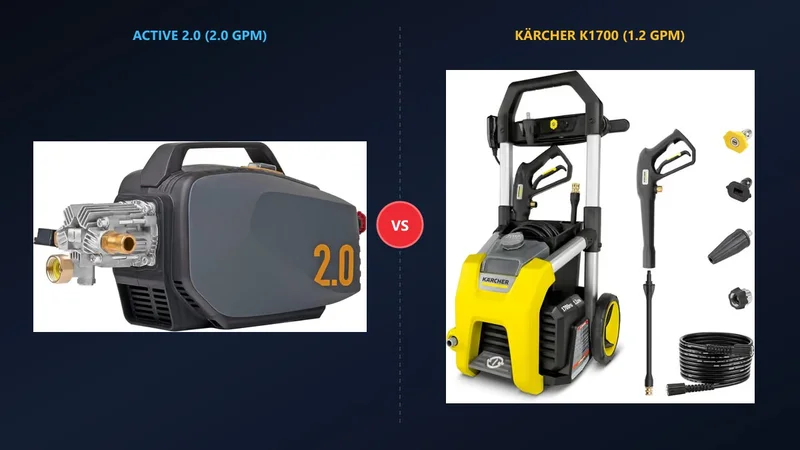
The Active 2.0 is the clear winner for automotive detailing. Its patented 5-piston pump flows a genuine 2.0 GPM at 1,000 PSI. That extra water flow builds thicker foam and cushions clear coats during wash passes. The Kärcher K1700 remains the budget champion at half the price. It delivers reliable 1.2 GPM flow with a handy foot-switch pedal for general chores and occasional car washes.
The Workbench Verdict: Which Detailing Rig Fits Your Budget?
- Top Pick for Enthusiasts & Weekend Warriors: Active 2.0 — Built specifically for car care. Its 5-piston pump delivers smooth, pulsation-free 2.0 GPM flow. It blankets paint in thick foam and cuts vehicle rinse times in half.
- Best Value for Weekend Chores: Kärcher K1700 (or K1700 Cube) — Under $160 out the door. It delivers a compact footprint, hands-free foot switch, and standard M22-14mm brass fittings. It's a proven entry rig for clean garage setups on a budget.
Mechanical Engineer's Note: Flow Mechanics in Automotive Detailing
Most consumer pressure washers are built to blast dirty driveways. They push high pressure (1,700 to 2,000 PSI) with anemic water flow (1.1 to 1.2 GPM). On automotive paint, excessive pressure is risky. It can lift stone chips and etch thin clear coats. Water volume is what actually protects your finish. We measure that fluid balance using hydraulic horsepower:
A standard 120V 15A garage breaker limits electric motors to roughly 1.5 to 1.8 mechanical HP. Kärcher routes that power into 1,350 working PSI at 1.15 GPM (1,550 Cleaning Units). Active takes a smarter route for detailing. It trades excess pressure for fluid volume, delivering 1,000 working PSI at 2.0 GPM (2,000 Cleaning Units) through a 4.0 orifice nozzle.
That extra 0.85 GPM yields a 70% increase in water volume. It pulls hard through foam cannon venturis to create dense snow foam. The extra volume also forms a hydrodynamic cushion, washing away grit before wash mitts touch clear coat.
Product Showcase: Detailing Contenders
Both models are staple units in home detailing bays and mobile washing trailers. Here is how their industrial builds stack up:
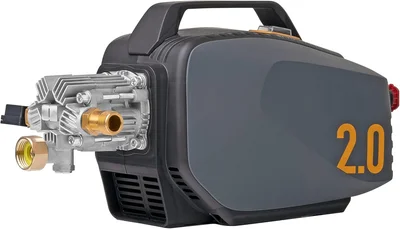
- Patented 5-Piston Wobble Pump: Ceramic-coated stainless steel pistons provide smooth, pulsation-free delivery.
- 2.0 GPM Real Flow Rate: Flows 2.0 GPM @ 1,000 PSI with a #4.0 orifice nozzle for maximum detailing foam.
- 250+ Operating Hour Duty Cycle: Engineered with rebuildable valves, replaceable seals, and brass outlet blocks.
- Standard M22-14mm Brass Connections: Connects to commercial swivel guns, UberFlex hoses, and quick-connect foam lances. Read our full standalone test in the Active 2.0 Detailing Review.
- Compact Rubber-Isolated Chassis: Weighs 22 lbs with vibration-absorbing rubber feet ideal for wall shelves.
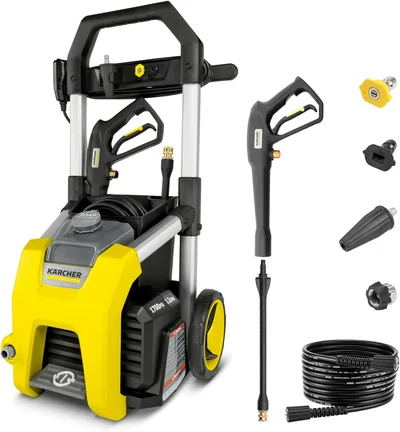
- 14-Amp Universal Motor: Reliable 120V powerhead with convenient on/off foot switch.
- 3-Piston Axial Cam Pump: Delivers 1,700 PSI Max (1,350 continuous working PSI at 1.15 GPM).
- Sub-$160 Price Point: Exceptional price-to-performance ratio for entry-level car washers and home chores.
- Standard M22-14mm Brass Connections: Unlike older Kärcher K-Series units with proprietary plastic clips, the K1700 features standard M22-14mm brass threads. Commercial hoses and spray guns screw straight on with no M22 14mm vs 15mm adapter required.
- Lightweight Maneuverability: Weighs 20.7 lbs (or 16.3 lbs in the Cube edition) with a removable storage bin.
Engineering Feature Matrix: Side-by-Side Specifications
To evaluate these two units for a detailing setup, compare their hydraulic performance and hardware specifications:
| Engineering Metric | Active 2.0 | Kärcher K1700 | Engineering Advantage |
|---|---|---|---|
| Pump Architecture | Patented 5-Piston Wobble Plate | Standard 3-Piston Axial Cam | Active 2.0: 40% less line pulsation; smoother trigger pull. |
| Piston Metallurgy | Ceramic-Coated Stainless Steel | Hardened Steel Pistons | Active 2.0: Superior abrasion resistance against water sediment. |
| Measured Detailing Flow | 2.0 GPM (@ 1,000 PSI / #4.0 Tip) | 1.15 – 1.20 GPM (@ 1,350 PSI) | Active 2.0: +70% water volume; faster, safer paint rinsing. |
| Cleaning Units (CU = PSI × GPM) | 2,000 Real Detailing CU | 1,550 Real Working CU | Active 2.0: +29% effective cleaning productivity. |
| Hose Fitting Standard | M22-14mm (Brass Collar) | M22-14mm (Brass Collar) | Tie: Both accept standard commercial hoses without adapters. |
| Motor Rating | 1800W / 14-Amp Universal (9650) | 14-Amp Universal Motor | Tie: Both max out standard 15A 120V household circuits. |
| Operating Noise Level | 82 dBA (Pulsation-Damped Whine) | 84 dBA (Standard Gear Whine) | Active 2.0: 5-piston frequency is less jarring to the ear. |
| Service Life / Rating | 250+ Hours (Rebuildable) | 100 – 150 Hours (Throwaway) | Active 2.0: Factory seal and check-valve rebuild kits available. |
| Power Switch Mechanism | Rocker Switch on Body | Hands-Free Foot Switch Pedal | Kärcher: Convenient foot-tap operation when hands are wet. |
| Form Factor & Shelf Mounting | Compact Box / Flat Base (22 lbs) | Upright or Cube (16.3 – 20.7 lbs) | Tie: Both fit easily on garage shelving or cart builds. |
| Amazon Pricing | ~$280 – $350 | ~$130 – $160 | Kärcher: Costs roughly half the price of the Active 2.0. |
Component Face-Off 1: Pump Architecture & The 5-Piston Advantage
Here's the technical difference that matters most: pump design. The Kärcher K1700 runs a standard 3-piston axial cam pump found in almost all consumer pressure washers. The Active 2.0 features a patented 5-piston swash plate pump.
Positive displacement piston pumps discharge water in pulses during each stroke. In a 3-piston pump:
- Pistons are positioned at a 120-degree angular separation.
- Each stroke leaves distinct pressure valleys between discharges.
- That hydraulic pulsation travels up the hose into the spray gun. It tires out your hands and accelerates wear on gun O-rings.
The Active 2.0 uses five smaller pistons arranged at a 72-degree angular offset. This tighter stroke spacing overlaps water delivery, cutting pressure pulsation amplitude by roughly 40%. Pull the trigger, and you get a buttery smooth water stream that feels like a commercial triplex pump. For teardown photos and full testing, read our Active 2.0 pressure washer review.
Engineer Field Test: 5-Gallon Bucket Flow Benchmarks
Retail boxes print theoretical GPM ratings with open outlets and zero nozzle resistance. Under real operating head pressure at the spray gun, flow drops. Here are the timed fill benchmarks using a standard 5-gallon wash bucket:
- Active 2.0 (with #4.0 Orifice @ 1,000 Working PSI): Fills 5 gallons in 2 minutes 30 seconds (Measured Flow: 2.00 GPM).
- Kärcher K1700 (with Stock Tip @ 1,350 Working PSI): Fills 5 gallons in 4 minutes 10 seconds (Measured Flow: 1.20 GPM).
Najam's Shop Rule: Flow rate dictates wash speed. The Active 2.0 moves 67% more water volume every minute. That extra water flushes soap suds and road film 40% faster. You'll shave 8 to 10 minutes off a wash. Dirt stays suspended in water, so you won't drag grit across the clear coat.
Component Face-Off 2: Foam Cannon Output & Chemical Siphoning
A snow foam cannon works via the venturi effect. Fast-moving water shoots through a constricted jet inside the brass body, creating a vacuum that pulls soap up from the bottle. That mixture hits a wire mesh screen to whip into thick foam.
Water volume (GPM) is the driving force behind that vacuum:
- Kärcher K1700 (1.2 GPM): The lower water volume pulls a moderate chemical draw. To get thick foam, you'll need to disassemble your cannon and swap in a 1.1mm orifice. Even then, the lower volume leaves a thinner lather that runs off paint quickly.
- Active 2.0 (2.0 GPM): Flowing 2.0 GPM pulls hard across standard 1.25mm foam cannon orifices. It produces dense, shaving-cream foam. The suds cling to vertical panels for 5 to 7 minutes, encapsulating grit before your wash mitt touches paint.
For custom soap mixtures and snow foam dilution rates, check our interactive Chemical Dilution Calculator.
Component Face-Off 3: Garage Detailing Bay Setup & Shelf Mounting
Both washers are popular choices for wall-mounted garage setups. Because neither unit uses gasoline or motor oil, you can mount them straight to a shelf alongside a retractable hose reel.
Key installation parameters to keep in mind:
- Active 2.0 Mounting: Features four heavy-duty rubber isolator feet on its steel base to soak up motor vibration. Its low profile (about 8.5 inches tall) slides neatly onto metal wire shelving. If you want a dedicated wall-mount unit, compare it against our top picks in the Wall-Mounted Garage Pressure Washer Guide.
- Kärcher K1700 Mounting: The K1700 Cube edition is a 12-inch compact box that takes up very little shelf depth. Keep in mind that its power switch is a foot pedal on the base. If you mount it up high, plug it into a switched wall outlet or use a wireless remote receptacle.
Fluid Dynamics Rule: The 50ft Detailing Hose Friction Loss
Detailers commonly swap factory 20ft hoses for a flexible 50ft line like the UberFlex hose. Friction loss scales with fluid velocity squared. Pushing 2.0 GPM through a 1/4-inch hose causes roughly 210 PSI of line friction loss on the Active, compared to 110 PSI on the Kärcher.
If you run a 50ft or 75ft hose with the Active 2.0, upgrade to a 5/16-inch or 3/8-inch ID hose. That eliminates fluid choke and keeps full flow at the gun. Check exact pressure drops across any line length using our Hose Friction Loss Calculator.
Component Face-Off 4: Duty Cycle & Rebuildability
Consumer pressure washers under $200 are typically throwaway appliances. When a check valve seat pits or a water packing tears, finding replacement parts is nearly impossible. Owners are forced to toss the whole machine.
This is where the Active 2.0 stands out:
- Active 2.0 Rebuild Kits: Active sells factory pump rebuild kits, replacement water seals, piston sets, and unloader valve cartridges. When you reach its 250-hour service life, you can rebuild the pump head on your workbench for cheap.
- Kärcher K1700 Sealed System: While durable for casual use, the K1700 relies on a sealed pump module. If winter freeze or cavitation cracks the manifold, replacement parts cost nearly as much as a new unit.
If either machine starts surging or cycling erratically, consult our troubleshooting guide on why electric pressure washers start and stop. Exploring other budget or mid-tier electric options for general home cleaning? Check out our comparison of the Sun Joe SPX3000 vs Greenworks Pro 2300.
Component Face-Off 5: The Turnkey Detailing Rig Budget
Experienced detailers rarely use the stiff plastic hoses or wands included in the box. You buy these units as bare powerheads, then add commercial detailing gear to build a proper garage bay rig.
If you're building a dedicated garage wash setup, here is how the real out-of-pocket investment shakes out:
| Rig Component | Active 2.0 Setup | Kärcher K1700 Setup | Practical Detailing Note |
|---|---|---|---|
| Base Powerhead | $349.99 | $149.99 | Kärcher cuts $200 off the base tool purchase. |
| Short Stubby Gun (Live Swivel) | $45.00 | $45.00 | Essential for tight wheel arches; live swivel stops hose kinking. |
| 50ft Commercial Flexible Hose (UberFlex) | $42.00 | $42.00 | No kinking; circles an entire truck without dragging the machine. |
| Brass 3/8" & 1/4" Quick Disconnects | $25.00 | $25.00 | Instant one-click setup from pump outlet to spray gun. |
| Wide-Mouth Snow Foam Cannon | $35.00 (with 1.25mm orifice) | $35.00 (with 1.1mm orifice) | Active runs standard 1.25mm; Kärcher needs a 1.1mm jet to build foam. |
| Total Turnkey Detailing Rig Cost | ~$496 | ~$296 | $200 Difference: Kärcher is the $300 weekend warrior sweet spot; Active 2.0 is the $500 enthusiast rig. |
Real-World Buying Decision: Which Should You Choose?
Choose the Kärcher K1700 If:
- Your budget is capped under $160 and you want proven reliability.
- You wash cars once or twice a month and also clean patio furniture, bins, and walkways.
- You want the convenience of a hands-free foot pedal switch.
- You don't mind slightly thinner foam and normal 1.2 GPM rinse speeds.
Choose the Active 2.0 If:
- You wash vehicles every week and demand true 2.0 GPM water flow.
- You want thick shaving-cream snow foam that clings to panels for 5+ minutes.
- You prefer the smooth, pulsation-free trigger of a 5-piston ceramic pump.
- You plan to build a dedicated wall or shelf setup with a 50ft hose.
- You want a rebuildable machine supported by factory valve and seal kits.